Bible Education

RSS Feed

Guest Carole Brewer on Babbie's House

Host Babbie Mason interviews author, speaker, & singer-songwriter, Carole Brewer about her book REVITALIZE; a Six-week Devotional designed to help busy women refresh and renew their Spirit. Get your FREE eBook download @ www.CaroleBrewer.com

Hebrew Dagesh = Two Types (Part 1)

A look at the dot found inside some Hebrew letters. https://www.jewishrootshistorychannel.com

Dagesh - How to Distinguish between two types (Part 2)

Simple Hebrew Lessons from Jewish Roots History Channel. https://www.jewishrootshistorychannel.com

Biblical Papyrus Photos

The earliest sources for the Greek New Testament are the papyri in codex (book-like) form. Of course, this designation came from the medium on which they were inscribed. At present, there have been over 139 of these discovered, with eighty of these manuscripts dating between 100 – 300 C.E., with the number increasing 21 more papyri from 290-390 C.E., with a total of 139, dating between 100-500 C.E. These biblical papyri range from a very small fragment to codices, which may be incomplete, but still contain large portions of several New Testament books. They are noted in literature with the Black letter character also known as Gothic script 𝔓, or by an upper- or lowercase “P” followed by a superscript Arabic number. (e.g., 𝔓52, 𝔓66, and 𝔓75).


P52 is the oldest manuscript of the New Testament known today. It measures 21/2 by 31/2 inches and contains only a few verses of the fourth gospel, John 18:31-33 (recto, the front), 37, and 38 (verso, the back). Bernard P. Grenfell acquired it around 1920, yet it went unnoticed until 1934 when paleographer C. E. Roberts took notice of the fact that it contained the Gospel of John. Roberts had evaluated the fragment, dating it to the beginning of the second century C.E. While other paleographers disagreed, other renowned scholars reached the same conclusion, including Frederic Kenyon, W. Schubart, Harold I. Bell, Adolf Deissmann, Ulrich Wilcken, and W. H. P. Hatch. P52 is very important because It establishes that the Gospel of John was written in the first century.


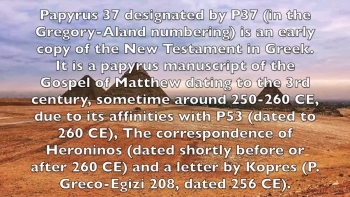
Papyrus 37 designated by P37 (in the Gregory-Aland numbering) is an early copy of the New Testament in Greek. It is a papyrus manuscript of the Gospel of Matthew dating to the 3rd century, sometime around 250-260 CE, due to its affinities with P53 (dated to 260 CE), The correspondence of Heroninos (dated shortly before or after 260 CE) and a letter by Kopres (P. Greco-Egizi 208, dated 256 CE).


The "Magdalen" papyrus was purchased in Luxor, Egypt in 1901 by Reverend Charles Bousfield Huleatt (1863–1908), who identified the Greek fragments as portions of the Gospel of Matthew (Chapter 26:23 and 31) and presented them to Magdalen College, Oxford, where they are cataloged as P. Magdalen Greek 17 (Gregory-Aland P64) and whence they have their name. When the fragments were finally published by Colin H. Roberts in 1953, illustrated with a photograph, the hand was characterized as "an early predecessor of the so-called 'Biblical Uncial'" which began to emerge towards the end of the 2nd century. The uncial style is epitomised by the later biblical Codex Vaticanus and Codex Sinaiticus. Comparative paleographical analysis has remained the methodological key for dating the manuscript, but there is no consensus on the dating of the papyrus. Estimates have ranged from the first century to the fourth century AD.


Papyrus 66 (also referred to as P66) is a near complete codex of the Gospel of John, and part of the collection known as the Bodmer Papyri. The manuscript contains John 1:1–6:11, 6:35b–14:26, 29–30; 15:2–26; 16:2–4, 6–7; 16:10–20:20, 22–23; 20:25–21:9, 12, 17. It is one of the oldest well-preserved New Testament manuscripts known to exist. Its original editor assigned the codex to the early third century, or around AD 200, on the basis of its style of handwriting.


Herbert Hunger later claimed that the handwriting should be dated to an earlier period in the middle or early part of the second century. More recently, Brent Nongbri has produced a broader study of the codex and argued that when one takes into consideration the format, construction techniques, and provenance of the codex along with the handwriting, it is more reasonable to conclude that the codex was produced "in the early or middle part of the fourth century." However, there has been a push to declare any manuscripts that includes John 6:4 to be of the 4th century or later. Refuting Brent Nongbri's astute claim is the works of a seasoned Christian literary scholar, the late Emeritus Professor of New Testament Language, Literature & Theology Larry W. Hurtado.


Papyrus 86 (in the Gregory-Aland numbering), designated by siglum
P86, is an early copy of the New Testament in Greek. It is a papyrus manuscript of the Gospel of Matthew. The manuscript palaeographically has been assigned to the 4th century. The surviving texts of Matthew are verses 5:13-16, 22-25.
Ketef Hinnom Silver Scrolls

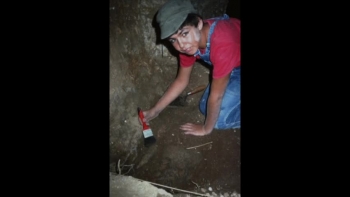
The Ketef Hinnom Silver Scrolls are an artifact that contains what may be the oldest surviving texts from the Hebrew Bible, dating from the First Temple period around the late 7th to early 6th century BCE prior to the Babylonian Exile, and are now preserved at the Israel Museum. The Ketef Hinnom Silver Scrolls were discovered at Ketef Hinnom, an archaeological site southwest of the Old City of Jerusalem, adjacent to St. Andrew's Church, now on the grounds of the Menachem Begin Heritage Center. It is located where the Valley of Rephaim and the Valley of Hinnom meet, on the old road from Jerusalem to Bethlehem. They were discovered inside of ancient burial caves, in 1979 when Gabriel Barkay was excavating an area on the outskirts of Jerusalem in the backyard of St. Andrews church. He had a group of 12 and 13 year old kids helping him. They discovered some tombs, but they were empty—having been looted long ago. One boy, Nathan, was given the task of cleaning out the dirt from the nooks under the burial benches. Like a true boy, he started banging the nook with a hammer. It broke, revealing an entrance to a secret chamber containing more than 1000 objects. There were 125 objects of silver, 40 iron arrowheads, gold, ivory, glass, bone, 150 semi-precious stones, and skeletons. The objects dated to the late 7th and early 6th centuries BC. Among the objects were two, tiny rolled-up silver scrolls 1” long.

How Skin color proves Creation & falsifies Out of Africa theory

In this video you prove to you using genetics that Biblical Creation is True and Evolution theory is NOT

TTSC Ep9: Magic Words vs. Powerful Words - What's the Difference?

May 17, 2020
When someone has a power you don't understand, it always seems like "magic." The Bible was translated into English in 1640AD, but before that time, it was only available in the Latin language - which nobody used anymore. People thought it was magic! Words sound magical and mysterious if you say them in a foreign language but that's not real power. If you want your words to have real power, you need to be clearly understood and you need to always speak the truth.

TTSC Ep8: Impossible Things Only Seem Impossible without God

May 10, 2020
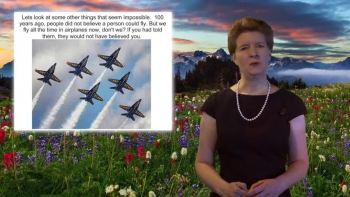
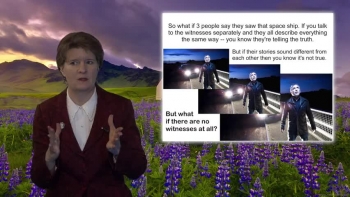
We live in a world of impossible things! Life on earth is so unlikely as to fall into the realm of impossibility - yet here we are! Defying the odds! How many of the impossible stories in the Bible have you resisted believing in order to avoid being picked on by small-minded scoffers? May I show you some impossible things in our world that are equally impossible? This is why the reliability of witnesses is so important when you learn new things. Our use of the word "impossible" says more about our own ignorance than it does about the world's possibilities....or about the God who created this world.

TTSC Ep7: Fruits of the Spirit, Weeds of the Flesh

You've heard of the Nine Fruits of the Spirit but what about the Nine Weeds of the Flesh? Today I present these practical contrasts to help viewers better understand their own fallen human nature. We are all born with weeds in our souls that grow out of our worldly desires for self-gratification. It's time to call them out and pluck them out!

TTSC Ep6 What is Definition of True Love?

April 26, 2020
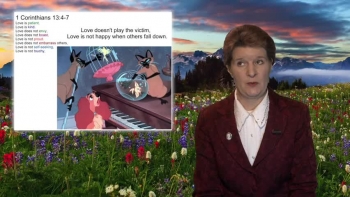
With as many stories we write about true love, it is very rare to hear it correctly defined. The Bible defines true love in 1 Corinthians 13:4-7 with qualities that are rarely achieved in our generation. Love is not feelings. It is the fruit of your character combined with your loyalty to others. This episode breaks it down in simple terms and shows that only Jesus Christ has ever demonstrated perfect love.

TTSC Ep5 God's Mercy at a Time of Judgment: What Really Happened in Sodom?

April 19, 2020
How often we forget the great mercy that God showed Sodom when Abraham bargained for Sodom's preservation. As wicked as it was, God was willing to relent if there were just 10 righteous persons in the city. Alas, there were only 4. What will be the numbers at the end of our age when the Two Witnesses predicted in Revelation 11 preach repentance to a world gone mad?

TTSC Ep4 When Jesus Knocks on the Door of Your Heart

April 12, 2020 Resurrection Sunday
In today's lesson I describe how I invited Jesus into my heart at the age of 5. When Jesus knocks on the door of your heart, you can invite him in forever. But this is not for everyone nor can it be done casually or at the behest of friends or relatives. It's YOUR heart. This is YOUR life. When Jesus comes in, it is the Holy Spirit who becomes your teacher as you read the Bible and pray each day. (You don't need a religious guru telling you what to think.) All you need is a repentant heart in order to "hear" him knocking.

TTSC Ep3 God's Cosmic Clock and His 4 Favorite Holidays

April 5, 2020
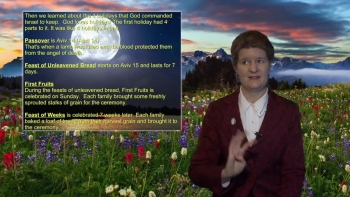
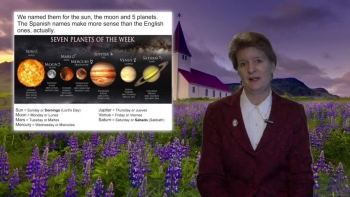
How did time begin? The universe is a clock! We, like the little mouse in the nursery rhyme, are running up and down this astro clock as we ride this earth in its orbit around the sun. God established 4 "forever" holidays that are recorded in Leviticus 23 that are scheduled according to the astro clock.
Passover/First Fruits/Unleavened Bread/Feast of Weeks = 1st Holiday.
First fruits celebrates with raw grain but Feast of Weeks with baked yeast bread. Christian fulfillment versions are: Passover = Good Friday, First Fruits = Easter, Feast of Weeks = Pentecost (Anointing of the Holy Spirit to believers)

Rosh Hashanah = 2nd
Yom Kippur = 3rd
Sukkot = 4th
One day, in the Kingdom of God, we will ALL celebrate Sukkot because we will all finally be "home."

--------------------------------------
Piano accompaniment by Nicole Pagnotta
All other music is sourced from Audioblocks.com

TTSC Ep2 Why was the Bible Written, Anyway?

March 29, 2020
In today's episode, I introduce a Bible search game that utilizes digital "easter eggs" and we read further about the essential purposes and trustworthiness of Scripture. How happy the world would be if all people obeyed the Ten Commandments! Alas! Without Jesus, all our best efforts are half-baked fakery.

The Time Traveler's Witness

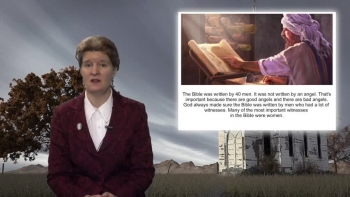
Lesson 1 tackles a question everyone should have answered before leaving church for the first time. That is, "Why should we read and love the Bible instead of the books of other popular religions?" What makes the Bible the Gold Standard for truthful records? Let me provide you with my favorite answer to this question.

ILS 2020 Commencement Ceremony

Congratulations to the ILS Class of 2020

What does it mean to speak in tongues

Student question

Children's Sermon on the Holy Spirit Comfort

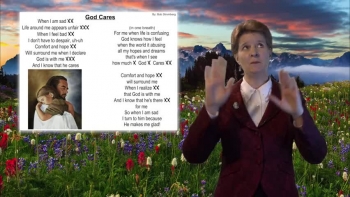
This message is based on the gospel of John 14:15-21. It reminds us that Jesus promised the Spirit to comfort us and be with us. We might not see Him with our eyes, but we know that God is always with us, and that gives us joyful hope!

This Bible Object Lesson will teach kids about the Holy Spirit. It’s based on John 14:15-21 where Jesus promised to send a comforter from God when he leaves the disciples. Download the teachers notes, watch our Children’s Message example, and gather your supplies. Then you’re ready to share this message in your church next Sunday!

https://ministry-to-children.com/holy-spirit-comforter-sermon/

https://ministry-to-children.com/wp-content/uploads/2020/05/childrens-sermon-The-Holy-Spirit-Comfort-Object-Lesson.pdf

Children’s Message: The Comforter
Jesus sends the Holy Spirit
Main Objective: In times of difficulty and trouble, it is a blessing to recognize that God loves us and cares about us no matter what. The goal of this message is to remind children that we can feel comforted by the presence of God. We can’t always hear or see Jesus in our midst, but He has given us the Holy Spirit, who helps and comforts us. We can rejoice in that, and we can also demonstrate Christ’s work in us by loving one another.

Law/Gospel Theme: Jesus not only promises us to be always with us, but He reminds us that His love should be appreciated and shared. We know that we cannot see God with our eyes, but through the comfort of the Holy Spirit we are given a way to have His presence near.

Optional Materials: Blanket, stuffed animal, pictures, “souvenirs” of loved ones

Bible Passage: John 14:15-21

Message: Note: As with most messages, the details of how you choose to communicate this are adaptable and should cater to timing as well as to your audience and student needs. Use your judgment and ideas to best serve students. This is a message that should take on a personal flair to it.


https://sundayschool.works/

https://ministry-to-children.com/bible/the-holy-spirit/

https://ministry-to-children.com/who-is-the-holy-spirit/

https://ministry-to-children.com/spirit-pinwheel-craft/

https://sundayschool.store/

https://ministry-to-children.com/jesus-gives-us-comfort-lesson/

What did Jesus look like?

What did Jesus look like?

First ... 38 39 40 41 42 ... Last

Sponsored Links

Devotionals

View All