Stewards of God’s Varied Grace (Part 1 of 2)
Ministries > Truth For Life with Alistair Begg
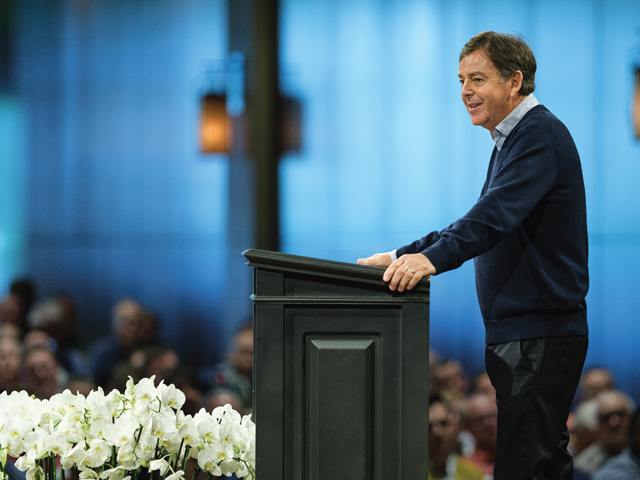
 Christ’s sacrifice secured salvation for all who trust in Him. It should also affect the way we think and live beyond the moment we first believe. On Truth For Life, Alistair Begg helps us understand what it means to live under the shadow of the cross.
-----------------------------------------
• Click here and look for "FROM THE SERMON" to stream or read the full message.
• This program is part of the series ‘The Stranger’s Hope’
• Learn more about our current resource, request your copy with a donation of any amount.
Helpful Resources
- Learn about God's salvation plan
- Read our most recent articles
- Subscribe to our daily devotional
Follow Us
YouTube | Instagram | Facebook | X
This listener-funded program features the clear, relevant Bible teaching of Alistair Begg. Today’s program and nearly 3,000 messages can be streamed and shared for free at tfl.org thanks to the generous giving from monthly donors called Truthpartners. Learn more about this Gospel-sharing team or become one today. Thanks for listening to Truth For Life!
Bob Lapine: As believers in Christ, our lives are changed once we accept what Jesus has done to secure our salvation. So how does Christ's death actually change us? Today on Truth For Life, Alistair Begg considers what it means to live under the shadow of the cross and in light of the end of days. How should that affect the way we live and think? Let's find out.
Alistair Begg: Father, as we turn to the Bible, we pray that you will take the truth, plant it deep in us, shape and fashion us in the likeness of the Lord Jesus, in whose name we pray. Amen. Well, first of all, then, living under the shadow of the cross, since therefore Christ suffered in the flesh. You'll note that he is picking up here from the eighteenth verse, I think, of chapter 3, where he has announced this: “For Christ also suffered. He suffered once for sins, the righteous for the unrighteous.” In some ways, he is following up on what he has already pointed out in chapter 2, in verse 24, concerning Jesus, “He himself bore our sins in his body on the tree, that we might die to sin and live to righteousness.” So the exhortation that is coming from the pen of Peter is, first of all, that those who are his readers will be thinking properly. Thinking properly. You will notice there in the text, “Arm yourselves with the same kind of thinking.” The same kind of thinking. And what is essential for the reader, for ourselves to understand, is that we dare not engage in the continual and irreconcilable war to which we referred yesterday, as per the Westminster Confession. We dare not go into that warfare without being armed properly. And our thinking has to be galvanized, structured by the truth of the Word. if you think about it in terms of the classic passage in Paul’s writings in Ephesians chapter 6, where he is saying to his readers in light of what they face, “Make sure that you put on the whole armor of God.” And as you know, part of that armor is the helmet of salvation: learning to think biblically, learning to think theologically, learning to think Christocentrally, and so on. when I think of that, I think of Martyn Lloyd-Jones in his little book, Spiritual Depression and Its Causes and Its Cures, where he says in there, you've got to be very careful that as a Christian, you're not listening to yourself, but you do need to learn to talk to yourself, and you need to talk sensibly to yourself, and you need to talk in terms of the truth of the Word. So when we take what is being said here in this opening verse and we clarify it in the words of Paul, I think we get an understanding of what Peter has in mind. I find it interesting, I'm sure you do too, that Peter, when in his second letter he refers to Paul, he says, you know, Paul has got a lot of things to say, and some of them are really hard to understand. Well, in this case, I think that Paul is a big help in helping us understand verse 1. So, for example, Paul writes, We were buried with him by baptism into death, in order that as Jesus was raised from the dead by the glory of the Father, we too might walk in newness of life. Buried in baptism, raised with him to a new life. And that, of course, he clarifies, we know that our old self was crucified with him in order that we should no longer be enslaved to sin. The power of sin has been broken, but it hasn't been eradicated. In our lives, sin no longer reigns, but it remains. And one of the evidences of the transformed life in a context like this is to suddenly say, can it possibly be that so many bright, educated, keenly engaging people are about to go and give up themselves, if you like, in order that they might increasingly see a world that knows and loves Jesus. And the answer to that is yes. If people from the outside were to try and adjudicate on what's going on, they would be hard pressed to find an explanation other than this fact that each has discovered that they are going to live their lives under the shadow of the cross. They are now living a forgiven life that is focused on the purposes of Jesus. she was a fairly high-ranking nurse in the south of England. Her name was Miriam, and she had, in the process of moving from England to Scotland, she had become a Christian. She arrived in her church in the west of Scotland and quickly settled in. And as I got to know her, she told me that soon after she'd arrived in Scotland, some of her old friends from the hospital structures of the south of England had come up to Scotland, had got in touch with her, and said to her, “Miriam, we are here, and we want to take you out on the town.” She demurred. her friends were surprised, and they said to her, “That doesn’t sound like the old Miriam.” To which she replied, “That is because I am not the old Miriam. I am now in Christ. I am a new creation, and I’m walking a different pathway.” Well, that all begins in our minds, thinking properly in light of God’s truth, and then in verses 2 and 3, inevitably living differently. Thinking properly, living differently. No longer, he says, for human passions, but rather for the will of God. In fact, the amount of mention of time here is significant through this whole chapter, for the rest of the time in the flesh. For the rest of the time in the flesh. What are you going to be doing with the rest of the time? What are you doing with the rest of your life? That's what people have started to ask me. It's quite unsettling. Apparently, you're going to stop doing what you're doing. Mark Thomas helped me. He said, don't call it retiring, call it redeployment. That will get them off your back for a little while. And it's worked, but they're still asking, what are you going to do with the rest of the time? Take my moments and my days, I guess, let them flow in ceaseless praise. Because we are no longer what we were. We were by nature children of wrath. Like the rest of mankind, we just lived for ourselves, to please ourselves. what he refers to as in the passions of the flesh, carrying out the desires of both the instincts of our bodies and of our minds. What has happened? Well, he says, we've been changed, haven't we? That's what we saw way back on Saturday night, which was about three weeks ago, and we realize that we've been born again to a living hope by the resurrection of Jesus Christ from the dead. It's not that we bumped into some religious program and decided to try it. It's that we have been raised out of darkness into light, that our feet have been taken out of miry clay, they've been put on a solid rock, and he's established our going. Paul again, But God, being rich in mercy, made us alive together with Christ. By grace you've been saved and raised up with him, seated with him in the heavenly places in Christ Jesus, so that in the coming ages he might show the immeasurable riches of his grace in kindness towards us in Christ Jesus. Oh, how the grace of God amazes me. For the rest of the time, I would say on average here, I haven't checked, but most of us, in human terms, have less time in front of us than we have behind us. Does that then mean that as the runway shortens, we slacken off, we idle away? You remember Charles Simeon when, after he had been going there for such a long time, he finished his ministry, I think, after 54 years, and he was a very devoted man, as you know, and he studied hard, and he rose in time, and so on. And they said to him, you know, Charles, you've done a wonderful job. Why don't you just relax and settle down and take it easy? You remember his reply? Shall I not run with all my might, now that I see the finishing line in view? That's when you have the spurt. That's when you have the kick, as they say in the Olympics, when you kick in. You don't slacken off and lie down in the grass. So a challenge to some of us who are redeploying, a challenge to myself. Kick in, you lazy Scottish rascal. Let's go. Let's go. Because after all, you have spent enough of your time, he says. The time that is past suffices for doing what the Gentiles want to do. Enough time on that. You've been going with the flow, he says. That was your pre-converted life. Anybody can go with the flow. Any dead fish can flow downstream. It takes a live fish to go up against the current. Timothy Dudley Smith, whose name is not only known here but probably revered, died in the last little while. He died, I think, on the 12th of August 2024. And when I was nine years old, he gave us his first of many hymns. His first was Tell out my soul the greatness of the Lord. And amongst his many hymns, my favorite is the one, Lord, for the years your love has kept and guided. And when he goes through, Lord, for the years, Lord for this, Lord for that, and he comes to, Lord, for ourselves, in living power remake us, self on the cross and Christ upon the throne. Past put behind us, for the future take us, Lord of our lives, to live for Christ alone. Now, when you read verse 3, you say to yourself, isn’t it amazing how timeless the Bible is? You would think that somehow or another, when we read this description in verse 3 about a place so far away at a time so long gone, we would have to somehow or another bring it up to date. We would have to contextualize it, if you like. But, you know, it's striking as you read verse 3, that the time is past now that suffices for doing what the Gentiles or the pagans want to do. What do they want to do? They want to live in sensuality, passion, drunkenness, ****** drinking parties, lawless idolatry. Basic, he says, debauchery. I mean, the devil’s questions have never changed since the Garden of Eden. Do you think God really said that? Do you think God really meant that? Do you think you can really trust God? And his Friday night party routine, it seems to me, has never changed over all the years. Whether you're in Bithynia or in Brisbane or in Cappadocia or in Cleveland or in Pontus or in Gate Parry or in Galatia or on the Gold Coast up there north of Brisbane, it's the same deal. Go and look. Walk into the city. What do you see? You see life that is hopeless. You see the worshiping of idols that are self-depleting. You see people investing themselves in the forlorn dream that somehow or another there is something out there, and yet they know that the more they reach for it, the less it is. That's what Peter is saying. You're thinking differently now, aren't you? He says. And you're living differently too. I think it's very, very important we recognize that we're actually not passive in this matter. That we're not passive in this matter. I remember speaking at a conference years ago in the north of England, and they had a singer before I started. And I can't remember the song, but it went something like this: No more trials, no more fighting, no more. And I said, what is this? And it was like the way to success in the Christian life is you sit down and do nothing. You let go of everything. And so I guess it's a succession of letting go, and eventually you got nothing left to let go, but you seem not to be making any further progress. And I was about to preach on work out your own salvation with fear and trembling. But I had no chance to alter, and so I just went for it. And I recognize that. We're not passive in this. I say to young people all the time, I tell them the story that was told to me as a young man about the chaplain in the Navy down in Portsmouth on the south coast. And he's standing there with a group of young sailors, and he's talking to them. And the sailors are saying, “You know, chaplain, if your collar wasn't turned around the wrong way and you lived in the real world, you would understand that we can't help a lot of the things we do. We’re just, we’re responding to forces, you know, that… And he said to them, he said, if you look out here on the bay, you will see that these yachts are going along. He said, one yacht goes east, one yacht goes west, by the selfsame winds that blow. It's the set of the sails and not the gales that determine which way they go. Oh, they said, I never thought about that way at all. Thinking properly, living differently, what can we expect? Abuse. It's there in the text. With respect to this, they'll be surprised when you don't join them in the same flood of debauchery, and they will malign you or abuse you. But you should also know that they will give account to the one who is ready to judge the living and the dead, because this is why the gospel has been proclaimed, proclaimed to those who are now dead, so that the judgment due to them as sinners, by embracing the gospel has been borne by Christ, bringing them, bringing us into a new spiritual life which abides beyond death in the company of the redeemed. Living, then, under the shadow of the cross. Living, secondly, verse 7, living in light of the end. The end of all things is at hand. History is not cyclical. I think we're agreed on that. It is linear. We live in between the two advents of the Lord Jesus. The Anglican Prayer Book helps as much as anything, especially for people that come out of a culture such as my own, to recognize the fact that when we, in the Anglican Prayer Book and in the liturgy and in the collects, we recognize that the advent of Jesus in his first coming is in direct relationship to his second coming. And so that Christmas, often I think at Christmas we have that Titus passage in Anglicanism, the grace of God that brings salvation has appeared to all men, speaking, of course, of the wonder of the incarnation. Whenever you read a phrase like, the end of all things is at hand, especially if you're in a local Bible study group, you know, put your helmet on because somebody is going to, you know, tell you exactly about the return of Jesus Christ, particularly when he will be coming. And I've always been excited when Murray McShane used to speak to his Bible study group, and sometimes for fun he would say to them at the end of the evening, and let me just ask you, do you think Christ will return before we have our next study together? And to a man, they all said, no, not at all. And then he said, well, you must always be ready, for the Son of Man is coming at an hour we do not expect. When we think in terms of when that will be, no one knows, not even the angels of heaven, which is quite a thought, nor the Son, the one who is coming, but the Father only. We don't know the when, but we do know the how. He will come in fulfillment of the promises that he has made and that the Scriptures provide us with. He will come in power to reign. He won't come as per his entry into Jerusalem riding on the foal of a donkey, but he will come in triumph, and he will come, as we've already noted, to judge the living and the dead. The end of all things is at hand. It's interesting, to me at least, that it would seem that over the years of my life, there has been a diminishing interest in the Second Advent, at least the circles in which I move. the end-time preachers seem to have silenced the trumpet call, if you like, but the vacuum, the vacuum has been filled by climate activists. It's that little lady Greta Thunberg that is on about the end of all things. She's wrong. If she'd read Genesis 9 with me this morning, she would realize that God is sovereign over all these things. And whatever our view might be of that, the fact of the matter is that God, in his goodness, is watching over that seed time and harvest and all these things. So the fiery trial, whether it was, as we think in terms of the Roman emperors, the fiery trial, he says, when it comes to test you, you shouldn't be surprised about that, as though something strange were happening to you. And the prospect of the end simply calls for Peter’s readers to do what he and his friends had failed to do in the garden, to do what Jesus had exhorted them to do: to control themselves, to stay alert, to watch, and to pray. And that’s exactly what he’s passing on now, isn’t it? Don’t be surprised at the fiery trial when it comes upon you to test you, as though something strange were happening to you. Rejoice. You share in Christ’s sufferings, that you may also be glad when his glory is revealed. If you’re insulted for the name of Christ, you’re blessed. The end of all things is at hand. Therefore, what? Well, be quick to pray. Quick to pray. Prayer is so hard, isn't it? I've listened carefully to these prayers. I've learned a lot about how to pray. So many of Free Church prayers are just rambling. This I found profoundly helpful. When my prayer is meager, I have to face the fact that I must be regarding it as supplemental rather than fundamental. When my time of preparation for teaching is far more about trying to understand a verb than it is about seeking God. These are the characteristics, he says, of somebody who is living in light of the end. Number one, prayer. Number two, sustained love. Sustained love, verse 8. Above all, right up there at the top of the list, keep loving one another earnestly. Loving one another earnestly. It's not mushy, it's not gushy. It's a love that goes out of its way to take the initiative. Broken relationships, love always takes the initiative. It's the kind of love that doesn't find faults, doesn't delight in looking around and finding things that are wrong. It's the kind of love that chooses, even when things are wrong, to overlook them. Because hatred stirs up strife, but love covers all offenses.
Bob Lapine: You're listening to Alistair Begg on Truth For Life. We'll hear more about Christian living on Monday. Along with teaching the Bible, we are passionate at Truth For Life about offering books and resources to help you gain a deeper understanding of God's Word and to make it easy for you to share God's Word with others. With the holidays beginning next week, our online gift store includes a guidebook to help you study the New Testament. It's called the New Testament Handbook, and this is a beautifully designed hardcover book filled with maps and timelines, genealogies, book summaries. There are charts that provide cross references to Old Testament prophecies. You'll find profiles of the biblical authors, so much more. This is a book that I own and something that I have turned to to provide a helpful overview when I'm spending time in a particular book of the Bible. The best way I can think of describing it, this is like a New Testament travel guide. The book will lead you through the important events for each book in the New Testament, from Matthew to Revelation. And we're excited to offer the New Testament Handbook to you for our cost of just $10. It's a terrific price. Supplies are limited, though, so make sure you order your copy early. Find out more about the New Testament Handbook in our online gift store at truthforlife.org/gifts, and take a few minutes to browse our entire collection of gospel sharing items to give as gifts this Christmas. And please take a moment to add a year-end donation at checkout. We rely on your financial support, and this is a time of year when we hope to hear from listeners. We are 100% funded by your donations. Your giving enables us to distribute this program and continue offering our books at publisher prices. Again, you can shop and donate at truthforlife.org/gifts, or if you'd prefer, call us at 888-588-7884. I'm Bob Lapine. Thanks for listening this week. There are people who think that if you live a good life, if you follow the teaching of the Bible, you'll be protected from suffering. But that's not what the Bible teaches. Monday, we'll find out what we should expect and how we should respond. The Bible teaching of Alistair Begg is furnished by Truth For Life, where the learning is for living.
Related Episodes
Elizabeth and Zechariah (Part 2 of 2)
Saturday, November 21
Suffering for Doing Good (Part 2 of 2)
Thursday, November 19
Suffering for Doing Good (Part 1 of 2)
Wednesday, November 18
About Truth For Life
Truth For Life distributes the unique, expositional Bible teaching of Alistair Begg. Studying God’s Word each day, verse by verse, is the hallmark of this ministry. In a desire to share the good news of the Gospel without cost as a barrier, the entire teaching archive is available for free download and resources are available at cost with no markup.
About Alistair Begg
Alistair Begg has been in pastoral ministry since 1975. Following graduation from The London School of Theology, he served eight years in Scotland at both Charlotte Chapel in Edinburgh and Hamilton Baptist Church. In 1983, he became the senior pastor at Parkside Church near Cleveland, Ohio. He has written several books and is heard daily and weekly on the radio program, Truth For Life. The teaching on Truth For Life stems from the week by week Bible teaching at Parkside Church. He and his wife, Susan, were married in 1975 and they have three grown children.Contact Truth For Life with Alistair Begg
Website
http://www.truthforlife.org/?utm_source=oneplace&utm_medium=sitelinks&utm_campaign=home
Mailing Address
Truth For Life
P.O. Box 398000
Cleveland OH 44139
Telephone (Customer Service)
888-588-7884 Domestic
400-543-6800 International
440-543-0522 ( Fax)


